


All writers are familiar with the sensation; you get a new notebook or a blank page on your computer, full of purpose, but you hesitate after writing the first couple of lines. Should it be perfect? Should it be coherent? Should it "sound" like a writer?
Here is why the concept of regretfully documented notebooks turns into an unexpected source of comfort!
Notebooks like these don't focus on refined language or well-thought-out reflections, but rather on the raw and unfiltered state of our minds. They are repositories for scattered notes, indecisive views, nocturnal musings, and the likes of stuff that one might not be willing to look at twice.
In a society fixated on flawlessness, they give authors a very unique thing: the freedom to make mistakes.
A Closer Look at Regretfully Documented Notebooks
These documented notebooks are a perfect description of the name: notebooks with notes you have not sufficiently developed in your mind before recording them. They have the raw, unedited, brain-dump version.
The journals, unlike structured ones or planners, are not designed to help you organize your life artfully. Rather, they show your life as it happens, because it is: crazy, emotional, full of ups and downs, and authentic.
There is often such honesty in them that it can be quite strange. You might see emotional rants alongside unfinished ideas, business plans next to grocery lists, or poetic lines juxtaposed with sheer nonsense. And that is exactly the point.
They recognize that most thoughts do not need to be perfect before they are recorded. In some cases, write down the ideas, or the ideas will become more meaningful after writing.
The Psychology Behind Writing Regretfully
One of the main obstacles that writers encounter is starting self-editing too soon. The mind begins criticizing the concepts even before they get written down.
Questions like:
- “Does this make sense?”
- “Is this good enough?”
- “What if someone reads this?”
These ideas disrupt creativity.
Documented notebooks take away the urgency involved. They present a secret corner where one can even allow the mind to wander. On a mental level, this lessens the barriers and promotes the state of flow.
Many authors have discovered that their most original ideas come to them when they stop trying to "perform" while writing. These journals work as a kind of mental release valve, allowing thoughts to exist without any repercussions.
Why Writers Need This Kind of Notebook
The main challenge for writers is not the lack of ideas, but forgetting them after coming up with them.
The notebooks, which are documented, accomplish this by deciding to speed as a first priority rather than perfection. They also enable you to write down thoughts in their original form before they vanish or become diluted.
Not only do they contribute to solving creative block issues, but they also help loosen the mind. Even if the sentences don't seem to connect, the writing process will flow naturally when there is no pressure to write well. Gradually, these notebooks turn into collections of creative work. A number of writers come back to them and discover a kind of inspiration they didn't realize they had through their own raw thoughts.
Design Philosophy and Aesthetic Appeal
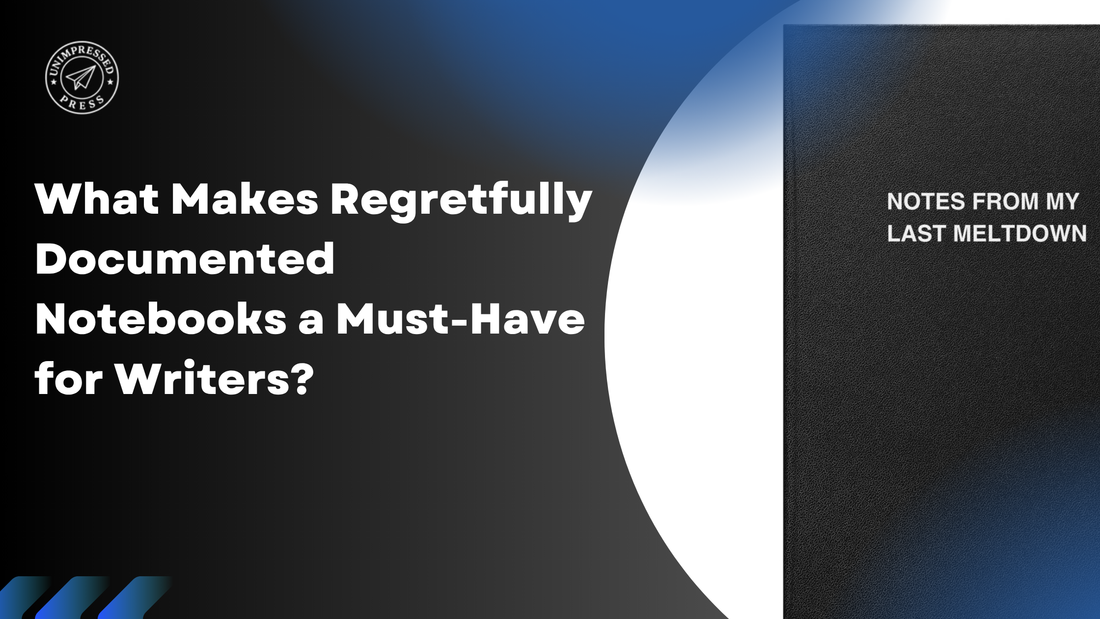
There's a quiet appeal in how regretfully notebooks are rarely designed as "regretfully documented" ones. They usually resort to minimalism not only to look neat but to avoid distraction. Fabric covers, simple typeset, and plain arrangements are a manifestation of the philosophy behind them: the focus must always be on the idea, not on the display.
This simplicity leads to a psychological change of mind. If a notebook is not considered "precious", you will probably use it without restraint. You will stop holding it as an art piece and start holding it as a place for thoughts. Paradoxically, this absence of pressure frequently results in the writing inside being more genuine and visually interesting in its own disorderly manner.
For a deeper look into why these notebooks are gaining so much love from writers and creatives, check out our full guide on Why Are Regretfully Documented Notebooks So Popular Among Creatives?
Real-Life Use Cases for Writers
These expression of thoughts notebooks can be a great addition to various creative processes:
- Journaling: Delivering emotions through one-way expression of thoughts or feelings.
- Content Creation: Getting ideas for blog articles, scripts, or social media posts.
- Academic Work: Initial freewheeling of ideas ahead of polished writing
- Creative Writing: Plot fragments, dialogue snippets, or random sparks of inspiration
- Daily Thinking Space: Somewhere to empty your mind of all its jumbled thoughts
They are not just for professional writers. People who think deeply can gain from them as well.
Why Regretfully Documented Notebooks Make a Difference
Look at the following key benefits of these notebooks:
1. Freedom from Creative Pressure
These documented notebooks provide the biggest advantages in terms of the freedom they offer. Writers do not have to try to "get it right" on their first attempt. There is no pressure to come up with perfect sentences or structured ideas. This freedom allows the thoughts to flow naturally, without the interruptions from self-judgment.
2. Capturing Ideas Before They Disappear
Creative thinking is typically rapid and transient. A powerful idea can disappear in a snap if it is not jotted down. Such jotters serve as an instant recording mechanism, enabling authors to keep first thoughts at hand before they are lost or weakened through excessive pondering.
3. Encouraging Honest Self-Expression
Because perfection isn't expected, writers are generally braver about being honest. Filming ideas simply and naturally without editing for idealized purposes, making the thoughts genuine, flawed, and real. Eventually, this establishes a stronger bond with one's own thought process.
4. Improving Long-Term Creativity
Entries may look untidy at first, but they can turn out to be very useful later on. Authors often go back to their old pages and discover hidden ideas, motifs, or understandings that they hadn't been aware of at first. Thus, the notebook turns into a creative resource for an extended period, not just a daily instrument for writing.
Unimpressed Press: A Space for Honest Writing Tools
One of the most notable names really living this philosophy is Unimpressed Press. At Unimpressed Press, notebooks come with a certain flair.
Life is full of chaos, deadlines, and horrible decisions; the stationery is meant to either make you smile or roll your eyes while you are dealing with life. They create witty, sardonic designs for folks who choose sarcasm rather than toxic positivity. Every notebook is an individual creation that beautifully combines quality materials with cutting humor and a blatant disregard for formalities.
The collections are designed for the unfiltered, overworked, and delightfully unimpressed by works like Deadlines, Headaches, and Tiny Acts of Defiance and Love Letters to My Bad Decisions. Also, every notebook has a fold-out inner pocket where you can stash scraps of paper, receipts, or business cards. There are 80 lined, cream-colored pages inside; perfect for your ideas, sketches, and daily musings.
Key Takeaway
Regretfully documented notebooks may not be something great on paper, and that is exactly what makes them so powerful. Each time, notebooks remind us that it is not necessary to polish every thought in order for it to be of great value. In essence, the significant ideas most of the time come out of messy, disorganized and slightly uncomfortable pages.
As more and more brands, for instance, Unimpressed Press, are adopting this mindset, writing is gradually drifting from perfectionism to honesty. And for writers all over the world, this change might be just what helps creativity.
Frequently Asked Questions
What does “regretfully documented notebooks” mean?
These are journals where ideas are jotted down in a very spontaneous manner without any sort of editing or worrying about structure, often recording raw and unpolished thoughts.
Are these notebooks only for writers?
Actually, they are great for whoever wants to jot down thoughts, come up with ideas, or even do some reflection without any pressure.
How are they different from regular journals?
Typically, journals are structured and have a purpose, whereas regretfully documented notebooks are unstructured and are solely focused on raw expression.
Why are they becoming popular?
Modern creators want to reflect their true selves and have clear minds rather than be perfect or overburdened with work productivity.


